Launch offer — valid today only

📄 Digital book in PDF · read it on your phone or print it

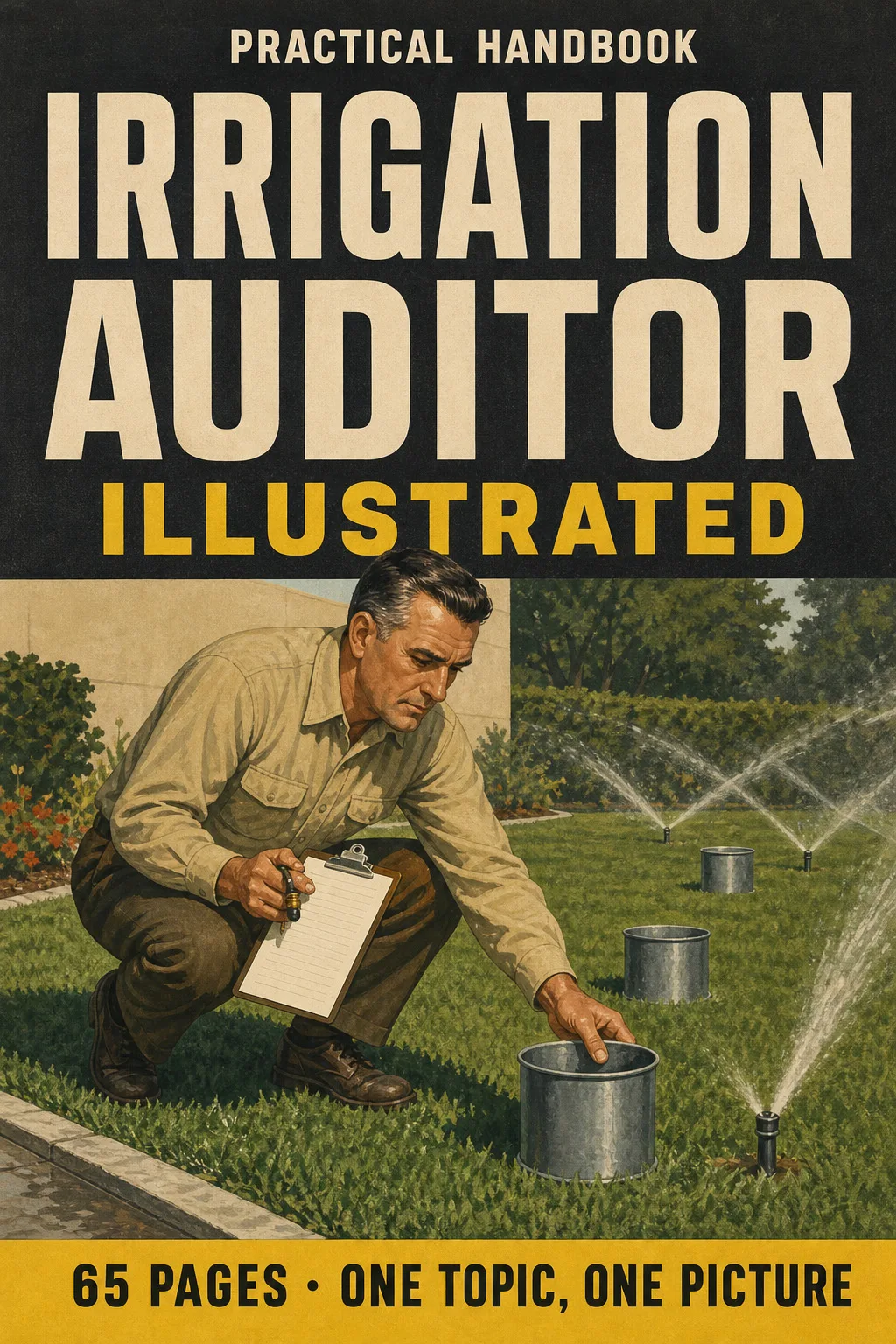
The Irrigation Auditor Exam in Drawings The Whole Audit in 6 Steps

1 Site. 2 Pressure. 3 Catch cans. 4 DU and precip rate. 5 Soil and ET. 6 Runtime and report. Every step gets its own pages: the drawing first, then the numbers you need, with worked examples. 65 illustrated pages.

START STUDYING THIS WAY

🔒 Secure checkout · PDF by email · 30-day guarantee

Every topic, its own pageEvery step of the audit drawn, with the explanation right beside it
65 illustrated pages9 parts, from what an audit measures to the audit day checklist
Up-to-date sourcesIrrigation Association audit guidelines, EPA WaterSense and your state's ET data (CIMIS in California)
PDF by emailFormat

Look Inside the Book

Every page has one big drawing and a box with the numbers and formulas you need to know:

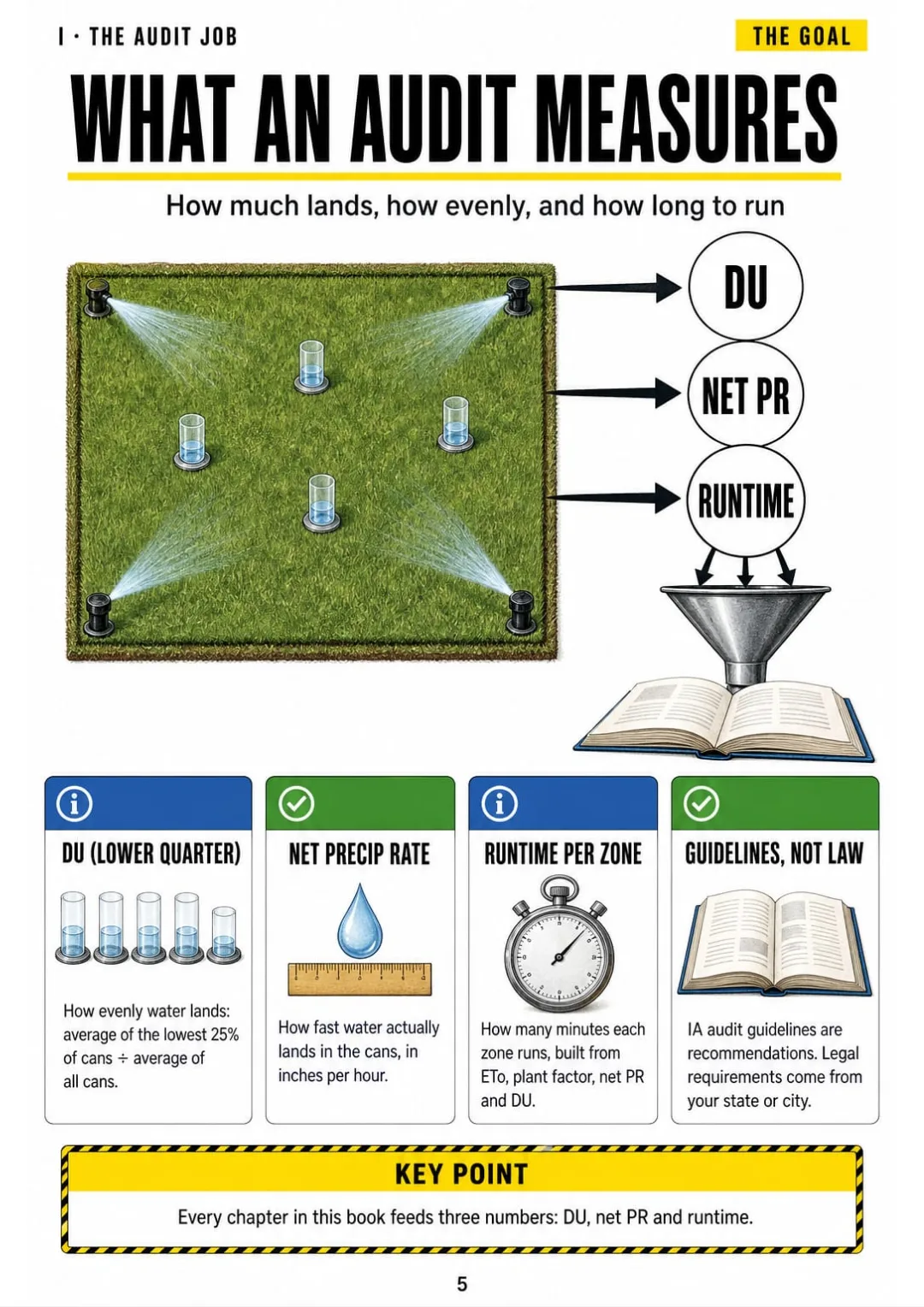
Three numbers come out of every audit: DU (lower quarter), net PR in in/hr, runtime per zone.
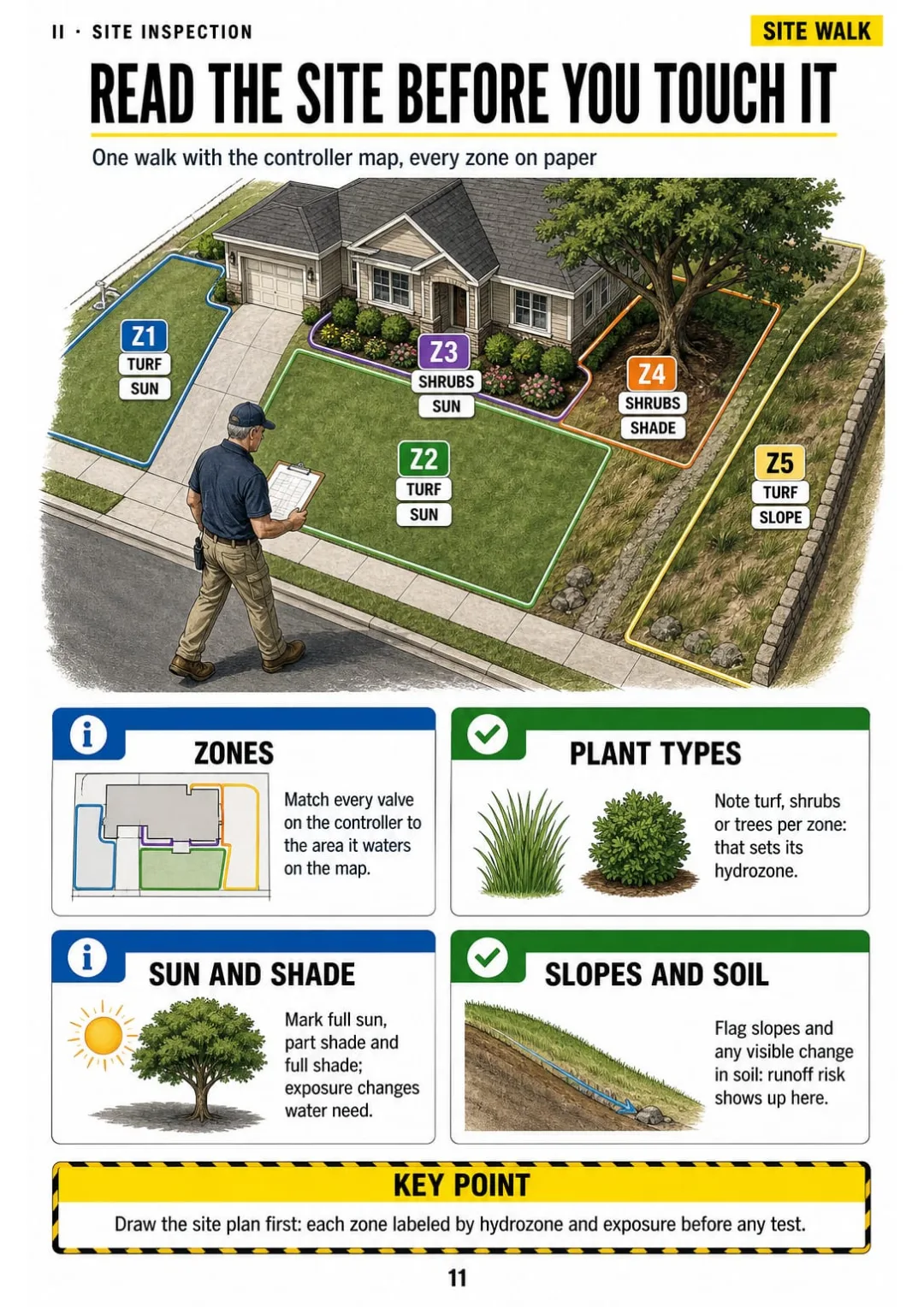
One site plan: 5 zones labeled by plant type, sun, shade and slope.
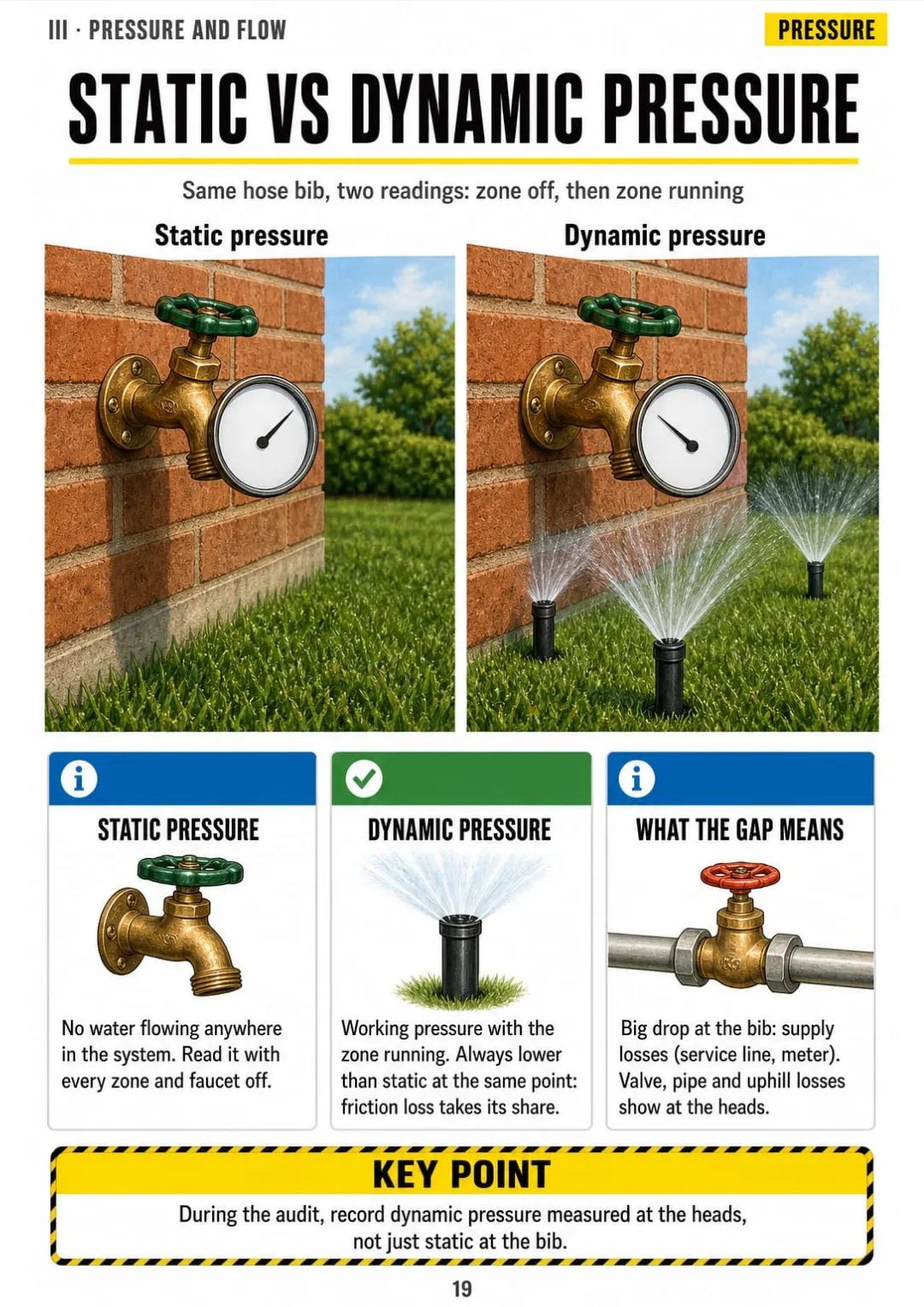
Static = no flow; dynamic = zone running, lower at the same point because of friction loss.
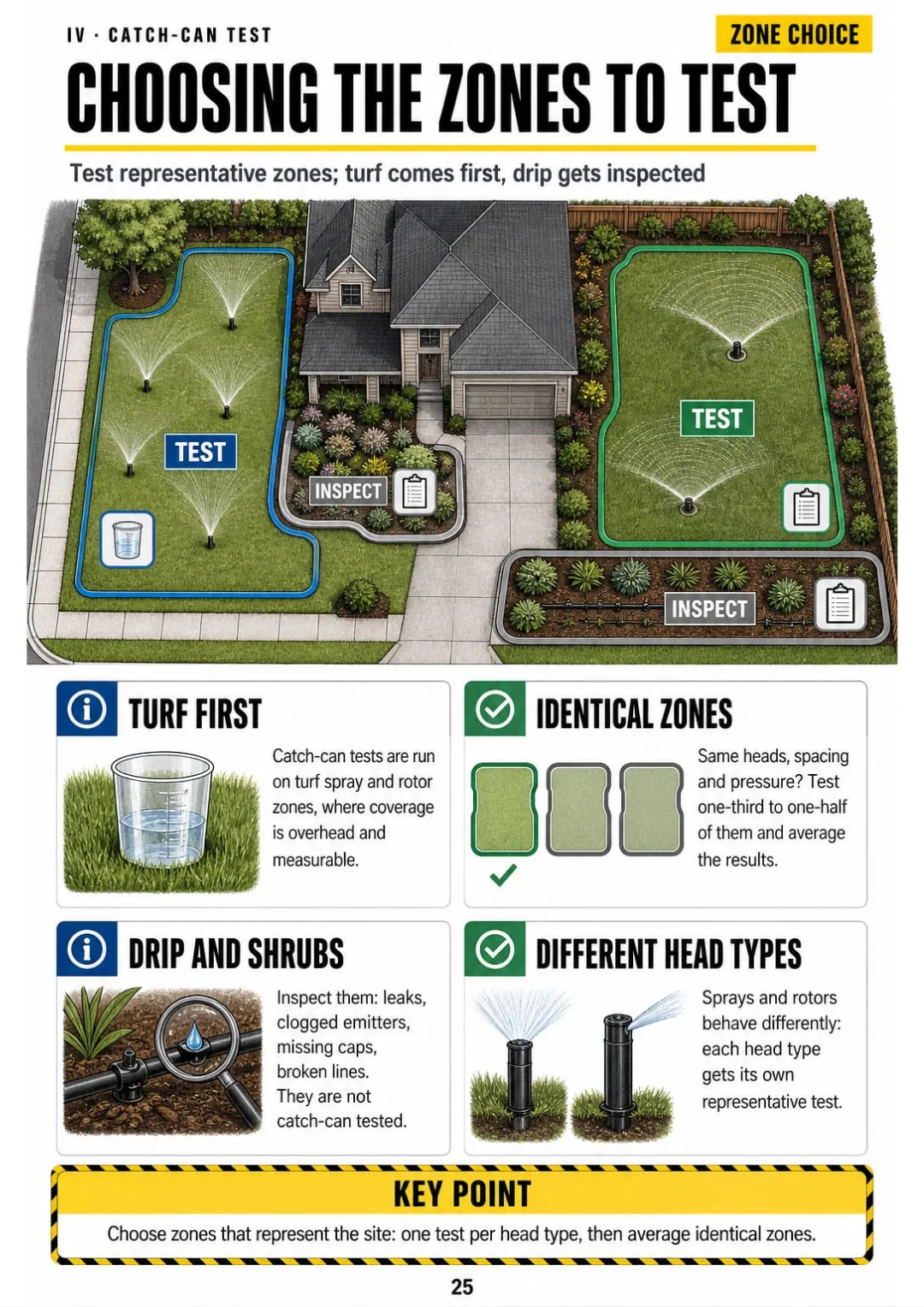
Identical zones: test one-third to one-half and average the results.
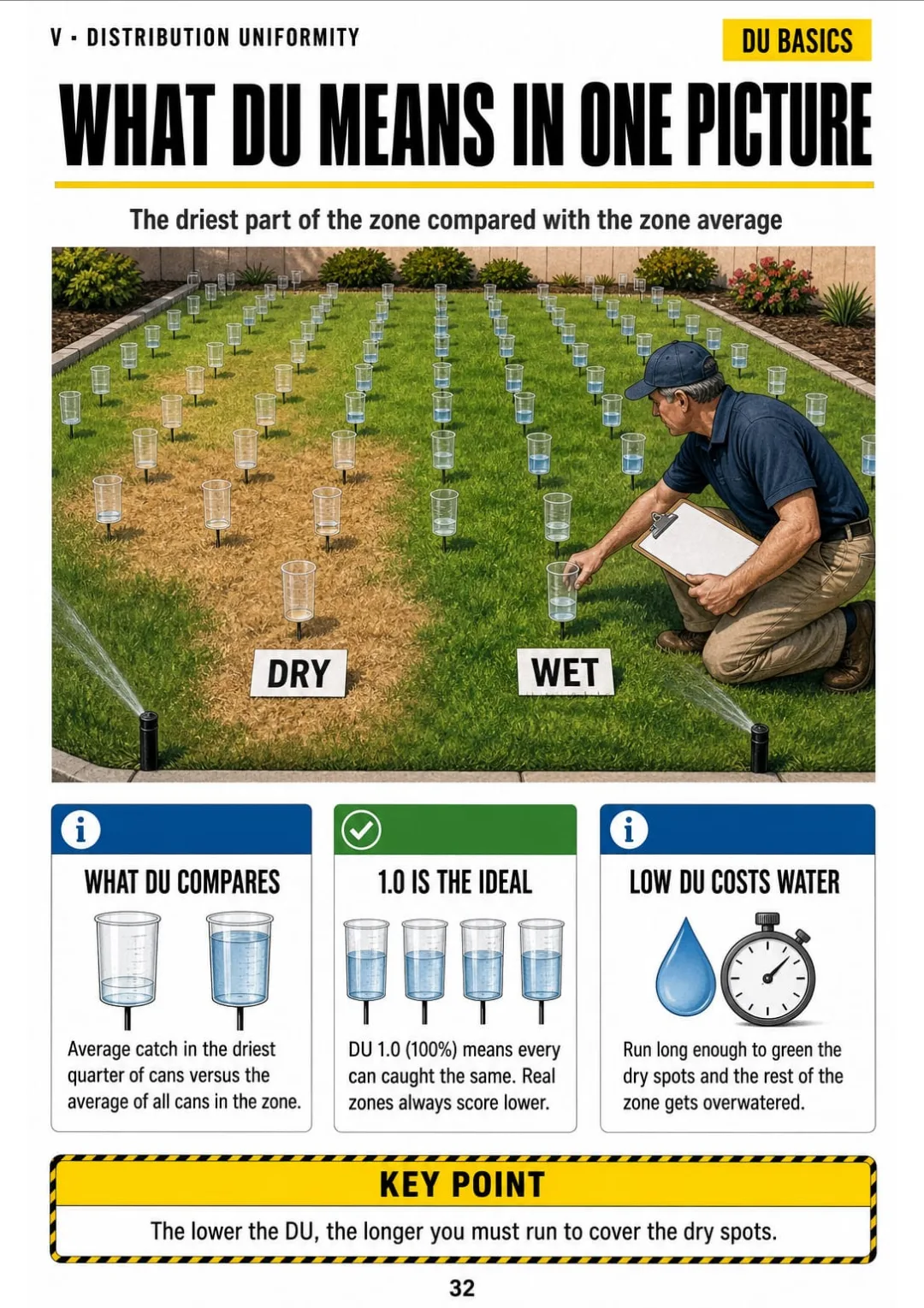
DU = driest quarter vs zone average: low DU means longer runtimes and overwatering.
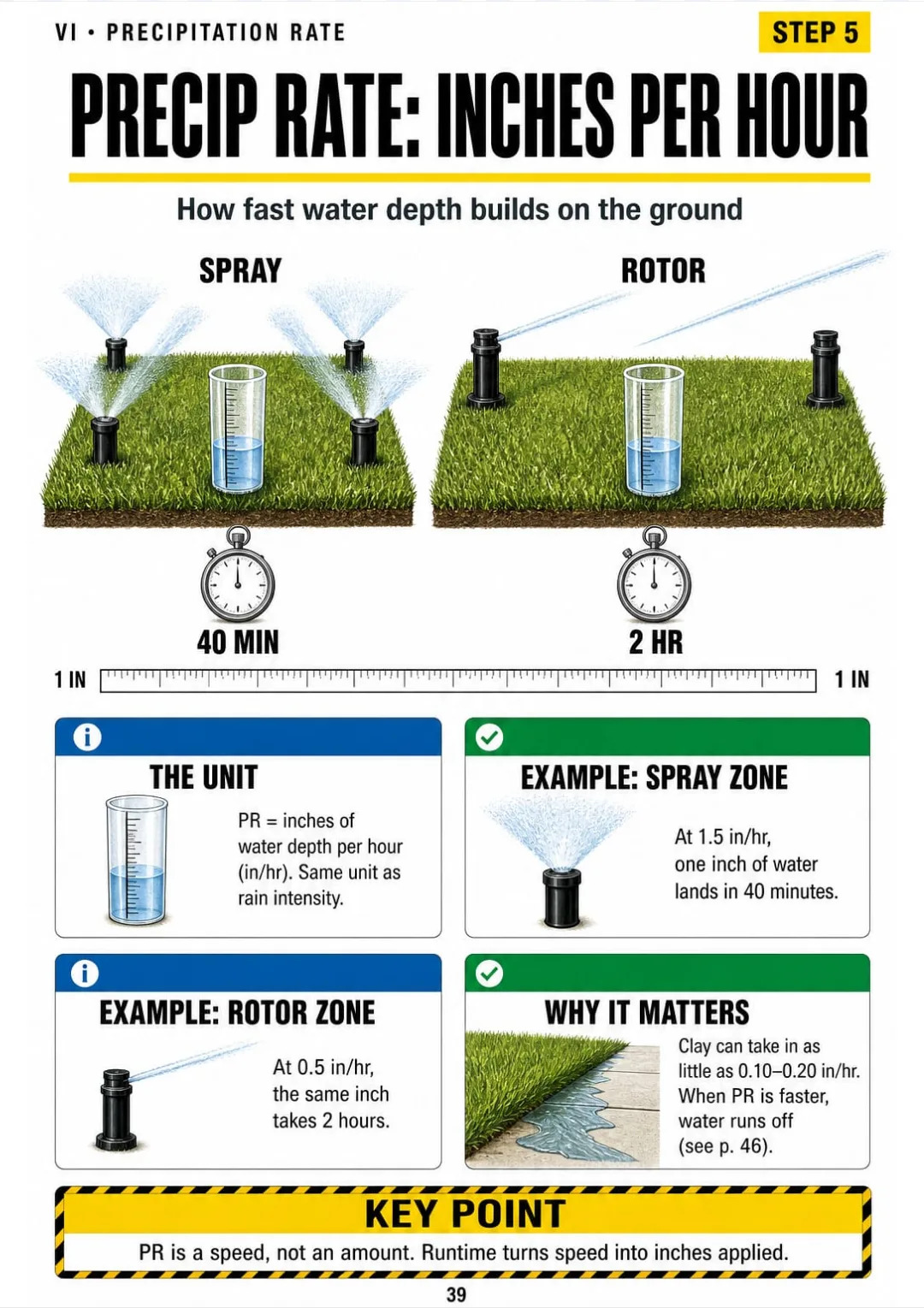
PR in in/hr: at 1.5 in/hr one inch takes 40 min; at 0.5 in/hr, 2 hours.
Ribbon test: sand, loam, clay, with typical water held per foot of soil
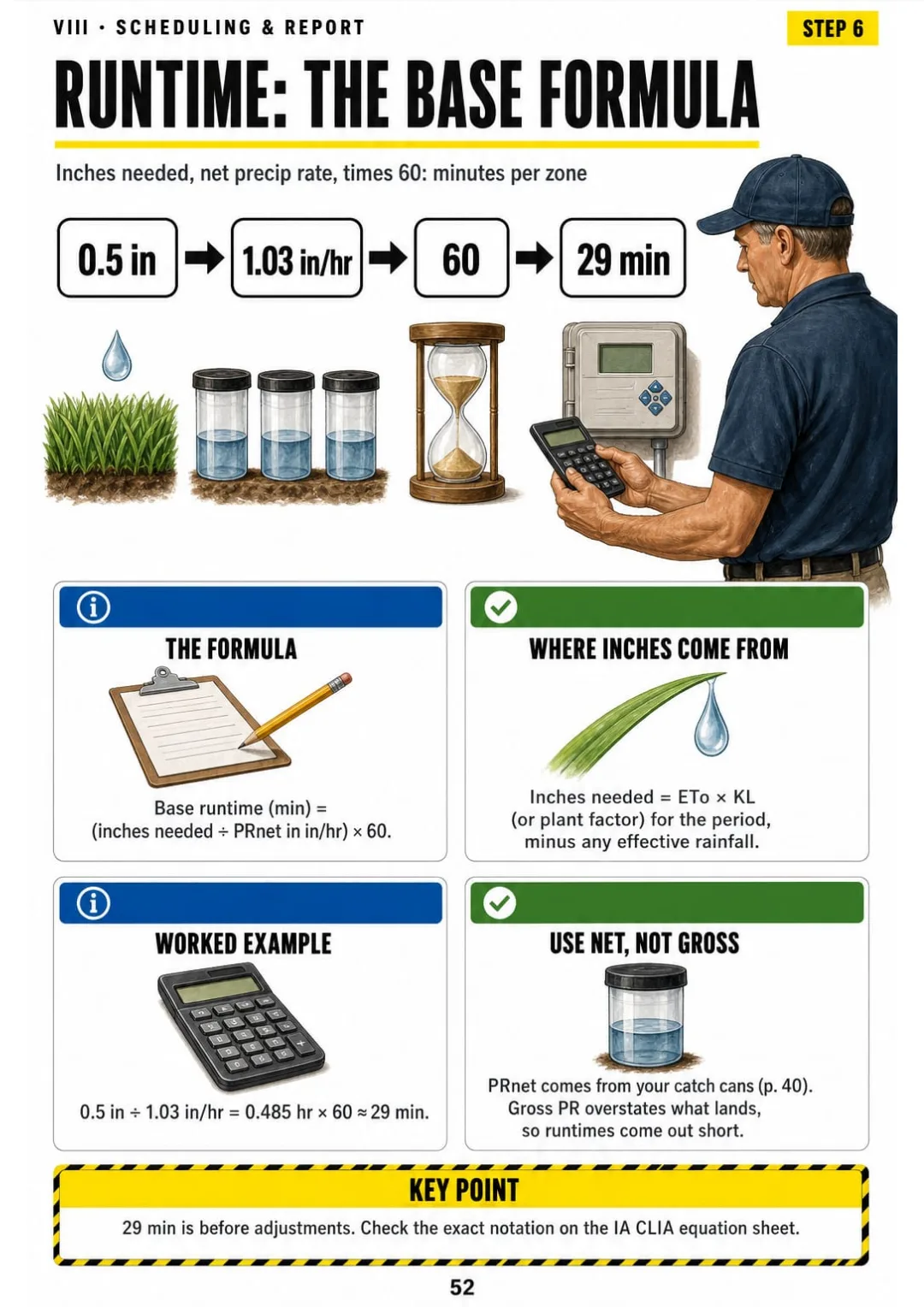
0.5 in ÷ 1.03 in/hr × 60 ≈ 29 minutes, before adjustments

Swipe to see more →

These are real pages from the book. The table of contents is the full one: 9 parts and 61 topics.

The Problem Isn't You. It's How It Was Explained.

You're at the hose bib with a gauge on it and the zone off. You turn the zone on and the needle drops. Which number goes on the sheet?

The manual covered it in three paragraphs on flow, friction loss and elevation. You read it at night, and by morning it was gone.

Static = no flow; dynamic = zone running, lower at the same point because of friction loss.

In the book it's one page: the same point drawn twice. Valve closed: static. Zone running: dynamic, lower because of friction loss.

Every other topic works the same way: the catch-can grid, the lower quarter, precip rate, soil texture by feel, runtime with cycle and soak. Each one has its own page.

You look at the gauge, you know what you're reading, and you write down the right number without going back to the manual.

COMPARE FOR YOURSELF

The Same Topic, Two Ways to Study It

THIS
  • The manual: line after line
  • Site inspections described only in words
  • You walk into the exam second-guessing yourself
Prior to the commencement of any field measurement, the auditor shall conduct a comprehensive evaluation of site conditions, including but not limited to the identification of hydrozones, plant material types, exposure to solar radiation, areas of partial or full shade, and changes in grade or slope that may affect runoff and infiltration. All irrigation zones shall be documented and correlated with the controller station assignments, and any observed deviations from the original design intent shall be recorded in the field notes for subsequent analysis.
FOR THIS
  • The whole site in one drawing
  • Zones, sun, shade and slope in one box
  • Each zone matched to its controller station
One site plan: 5 zones labeled by plant type, sun, shade and slope.
CONTENTS

Take a Look at the 9 Parts and 61 Topics

The audit job and the 6-step method, site inspection, pressure and flow, the catch-can test, DU, precip rate, soil and ET, scheduling and the report, and review and practice: 65 pages, all illustrated.

IThe Audit Job and the 6-Step Method · pp. 5-10
  1. What an irrigation audit actually measures
  2. The 6 steps, always in the same order
  3. Who asks for an audit and why
  4. The field kit, item by item
  5. US units you will use all day
  6. Gross vs net: the word that changes the answer
IIStep 1: Site Inspection · pp. 11-18
  1. Reading the site before you touch anything
  2. The controller: what to write down
  3. Point of connection, meter and backflow
  4. Spray heads vs rotors vs impacts
  5. Matched precipitation in one drawing
  6. Head-to-head coverage
  7. The defects checklist: what you flag and fix first
  8. Why you fix before you test
IIIPressure and Flow · pp. 19-24
  1. Static vs dynamic pressure
  2. Measuring pressure with a pitot tube
  3. Right pressure per head type
  4. Elevation and pressure
  5. Reading the water meter to get zone flow
  6. When measured flow and chart flow disagree
IVSteps 2 and 3: Catch-Can Grid and Measurement · pp. 25-31
  1. Choosing the zones to test
  2. Laying the grid on a spray zone
  3. Laying the grid on a rotor zone
  4. Test conditions: wind, time and timing
  5. Reading catch volume in mL
  6. The field sheet, filled in
  7. Spotting a bad test before you leave the site
VStep 4: Distribution Uniformity · pp. 32-38
  1. What DU means in one picture
  2. The lower quarter, marked in color
  3. DU lower quarter: the formula
  4. Worked DU example, step by step
  5. Rating the result
  6. Why DU is low: the usual causes
  7. From DU to the scheduling multiplier
VIStep 5: Precipitation Rate · pp. 39-44
  1. Precip rate: inches per hour
  2. Net PR from catch cans
  3. Worked net PR example
  4. Gross PR from GPM and area
  5. Gross PR by spacing: square vs triangular
  6. Why net and gross don't match
VIISoil, Plants and ET · pp. 45-51
  1. Soil texture by feel
  2. Infiltration rate vs precip rate
  3. Available water and root zone
  4. Allowable depletion (MAD)
  5. ETo: reference evapotranspiration
  6. Plant factor and landscape coefficient
  7. Hydrozones: grouping by water need
VIIIStep 6: Scheduling and the Report · pp. 52-59
  1. Runtime: the base formula
  2. Adding the scheduling multiplier
  3. How many days a week
  4. Cycle and soak
  5. Seasonal adjustment and smart controllers
  6. Water budget in gallons
  7. Writing the audit report
  8. Recommendations that hold up
IXReview and Practice · pp. 60-65
  1. One complete audit, start to finish
  2. The formula page
  3. Unit conversions on one page
  4. Most frequent math mistakes
  5. Most frequent field mistakes
  6. Audit day checklist

One Page, One Topic, All Clear

Think of it this way:

You're on an HOA's front lawn with 24 catch cans on the grid and the community manager watching. You need the DU before you leave the site.

You went over the DU page the night before: the cans drawn on the grass, the lower quarter marked in color, and the formula with every number in its place. You do the math right there, without opening the manual.

DU = driest quarter vs zone average: low DU means longer runtimes and overwatering.

Same with static vs dynamic pressure, net PR from catch cans, soil texture by feel, runtime with the scheduling multiplier, and cycle and soak: each one on its own page.

Irrigation Auditor Illustrated is 9 parts and 61 topics, all drawn, with one complete worked audit, the formula page and the most frequent mistakes at the end.

What you see drawn, you don't have to memorize.

What's Inside Irrigation Auditor Illustrated:

Ipp. 5-10

The Audit Job and the 6-Step Method

What an audit measures, the 6 steps in order, who asks for an audit, the field kit, US units, and gross vs net.

IIpp. 11-18

Step 1: Site Inspection

Reading the site, the controller, point of connection and backflow, sprays vs rotors vs impacts, matched precipitation, head-to-head coverage, and the defects checklist.

IIIpp. 19-24

Pressure and Flow

Static vs dynamic pressure, the pitot tube, the right pressure per head type, elevation, and zone flow from the water meter.

IVpp. 25-31

Steps 2 and 3: Catch-Can Grid and Measurement

Picking the zones to test, laying the grid on spray and rotor zones, test conditions, reading mL, the filled-in field sheet, and spotting a bad test.

Vpp. 32-38

Step 4: Distribution Uniformity

DU in one picture, the lower quarter in color, the formula, a worked example, rating the result, the usual causes of low DU, and the scheduling multiplier.

VIpp. 39-44

Step 5: Precipitation Rate

Precip rate in inches per hour, net PR from catch cans with a worked example, gross PR from GPM and area, square vs triangular spacing.

VIIpp. 45-51

Soil, Plants and ET

Soil texture by feel, infiltration vs precip rate, available water, MAD, ETo, plant factor and landscape coefficient, and hydrozones.

VIIIpp. 52-59

Step 6: Scheduling and the Report

The base runtime formula, the multiplier, days per week, cycle and soak, seasonal adjustment, water budget in gallons, and the audit report.

IXpp. 60-65

Review and Practice

One complete audit start to finish, the formula page, unit conversions, the most frequent math and field mistakes, and the audit day checklist.

At the end of the book: One complete worked audit, a formula page, unit conversions on one page and the most frequent math and field mistakes.

Plus: 2 Free Books

Irrigation Auditor Practice Book: Exam-Style Questions with Answers

BONUS 1: «Irrigation Auditor Practice Book: Exam-Style Questions with Answers»

Value on its own: US$ 17.90

Practice every topic with exam-style questions and an explained answer for each one, so you find your weak spots before exam day.

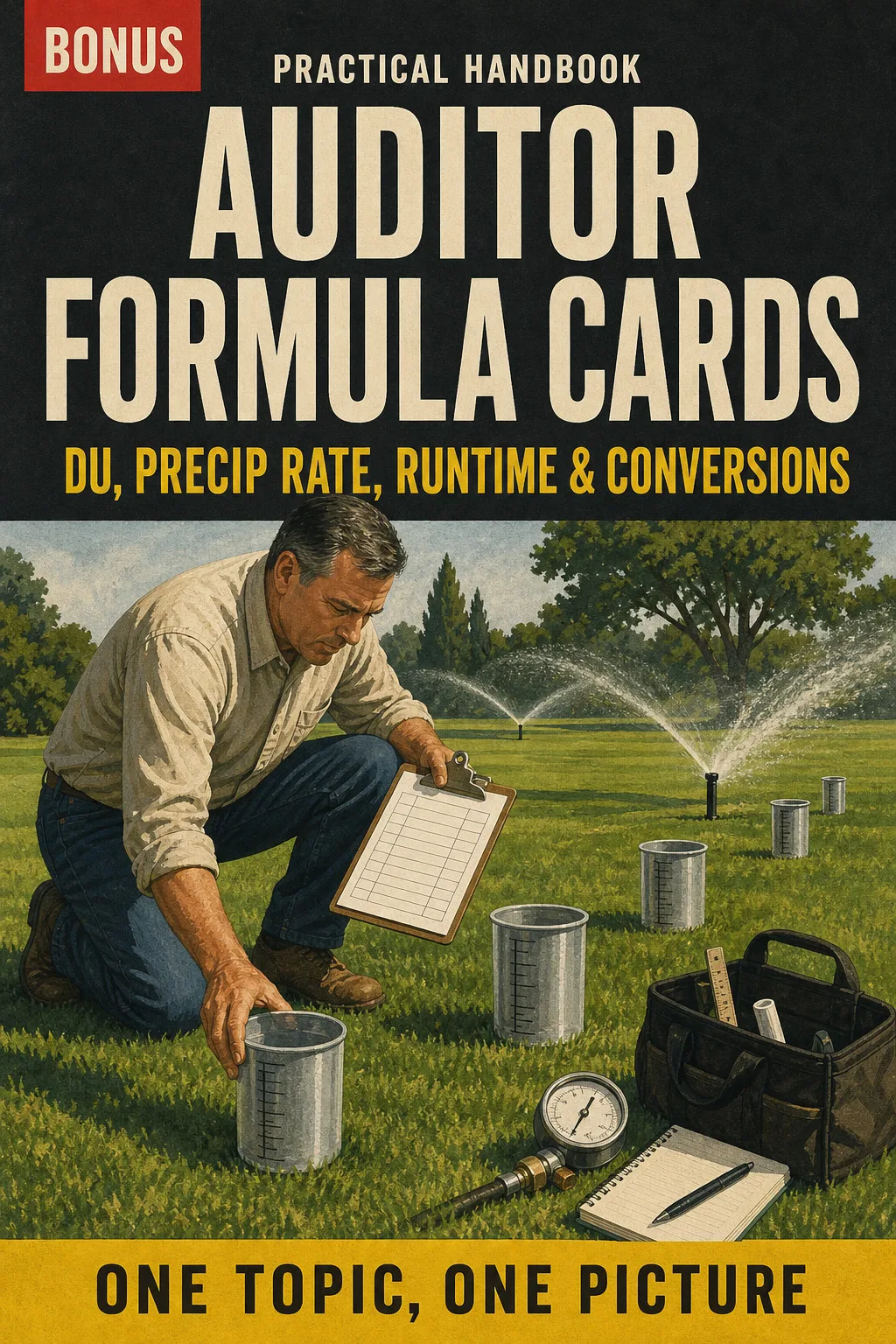
Auditor Formula Cards: DU, Precip Rate, Runtime & Conversions

BONUS 2: «Auditor Formula Cards: DU, Precip Rate, Runtime & Conversions»

Value on its own: US$ 14.90

All the formulas and unit conversions on a few printable cards you can keep in the truck and review in five minutes.

Irrigation Auditor Illustrated with 2 Free Books

  • Irrigation Auditor Illustrated: 65 illustrated pagesUS$ 63
  • BONUS 1: Irrigation Auditor Practice Book: Exam-Style Questions with AnswersUS$ 17.90
  • BONUS 2: Auditor Formula Cards: DU, Precip Rate, Runtime & ConversionsUS$ 14.90
  • High-resolution PDF to printIncluded
Total value US$ 95.80
YOUR PRICE:
US$ 27
You save US$ 68.80
YES, I WANT IRRIGATION AUDITOR ILLUSTRATED FOR US$ 27

📄 This is a digital PDF book sent to your email: nothing is printed or shipped.

Secure purchaseEncrypted payment30-day guarantee

PDF by email: We email you Irrigation Auditor Illustrated as a PDF, together with the two free books. It's a single payment: no installments, no extra charges.

Who This Book Is For

You're studying for the auditor exam

You're studying for the auditor exam

Every formula is drawn, with worked examples in inches, GPM and PSI, so the math stops being the part you dread.

Your exam date is close

Your exam date is close

The formula page, unit conversions and the most frequent math mistakes, to review in one evening. The practice book shows you your weak spots.

You already run audits

You already run audits

Print it and keep it in the truck to check the catch-can layout or the runtime math on site before you hand in the report.

Everything You Get Today

US$ 95.80US$ 27
YES, I WANT IRRIGATION AUDITOR ILLUSTRATED FOR US$ 27

📄 This is a digital PDF book sent to your email: nothing is printed or shipped.

30DAYS
GUARANTEE

30-Day Guarantee

Try Irrigation Auditor Illustrated for 30 days, bonus books included.

We refund everything if the file won't open, if the book isn't what you see here, if you were charged twice or if the email doesn't arrive. Just email us.

You pay once. No subscriptions.

Frequently Asked Questions

Is it for me if I've worked in irrigation for 20 years and haven't studied in a long time?

Yes. It's not a beginner's gardening book. It assumes you know the systems and focuses on what the exam asks: the audit method and the math. Every formula comes with a worked example, step by step, with real numbers in inches, GPM and PSI: DU from catch-can readings, net and gross precip rate, runtime with the multiplier, and cycle and soak. There's also one complete audit worked from start to finish.

Where does the content come from?

From the Irrigation Association's recommended audit guidelines and the published content outline for its auditor exam, cross-checked with EPA WaterSense specifications. ET examples use reference ET (ETo); in your state, use your local ET source (CIMIS in California, your state climate network elsewhere).

Is this official material?

No. It's independent study material. It isn't published, endorsed or reviewed by the Irrigation Association, the EPA or any certifying body, and it doesn't give you a certification: you still register and take the exam with your certifying body. The book is for studying the method and the math before you go.

Does it replace the course or field training?

No. It's a book for studying and review. It doesn't replace an official course, hands-on field training or your certifying body's materials.

Are the practice questions the ones on the exam?

No. They're written for this book, in exam style, so you can practice each topic. They aren't official questions from any exam.

When and how do I get it?

The book and the 2 bonus books come as PDFs by email, sent to the address you enter at checkout.

Do I have to pay every month?

No. It's a one-time payment, with no subscription.

Can I get it on paper?

It's a PDF you can print at home or at a print shop, then keep in the truck.

How does the refund work?

You have 30 days. We refund everything if the file won't open, if the book isn't what you see on this page, if you were charged twice or if the email doesn't arrive: just email us.

Before You Close This Page

No more rereading without anything sticking.

Static vs dynamic, DU and runtime: you see them drawn, and that's it.

You walk into the exam knowing where everything is.

Drawings make studying faster.

The book is right below.

One-time payment: US$ 27 · Guarantee: 30 days · PDF by email

YES, I WANT IRRIGATION AUDITOR ILLUSTRATED FOR US$ 27

📄 This is a digital PDF book sent to your email: nothing is printed or shipped.